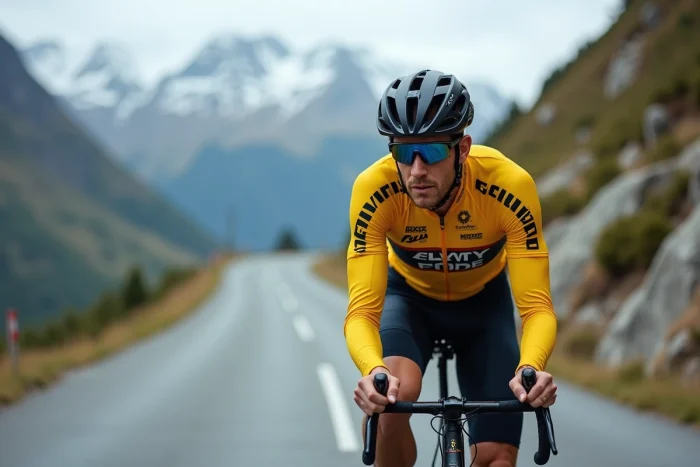
Winning the Tour de France, the Giro d’Italia, and the Vuelta a España during a career is not just a matter of having a well-stocked palmarès. This triple feat requires mastering three terrains, three calendars, and three radically different racing styles. Only a handful of riders have achieved this, and their profiles tell as much about the evolution of cycling as about their individual qualities.
What the triple crown demands on the ground
It is often imagined that a dominant climber can tackle the grand tours without adaptation. The reality is rougher. The Giro places its hardest climbs in the last two weeks, often on narrow and poorly paved roads.
The Vuelta imposes short, steep climbs, with temperatures that turn the peloton into an open-air oven. The Tour de France, on the other hand, combines long time trials and windy flat stages where positioning in the peloton can cost the race.
A rider capable of winning all three must therefore be versatile in the most concrete sense of the term: climbing, time trialing, and enduring the heat. This combination can be found among the few cyclists who have won all three grand tours, and it remains the most selective filter in professional cycling.
The calendar itself complicates matters. The Giro and the Tour are only a few weeks apart. Aiming for both in the same year requires a prolonged peak of form, or the choice to sacrifice one edition to better target the other. Jacques Anquetil, the first rider to achieve this triple, alternated his goals from one season to the next, while Eddy Merckx sometimes tried to win everything in the same year.
Anquetil, Merckx, Hinault, Contador: very different racing profiles
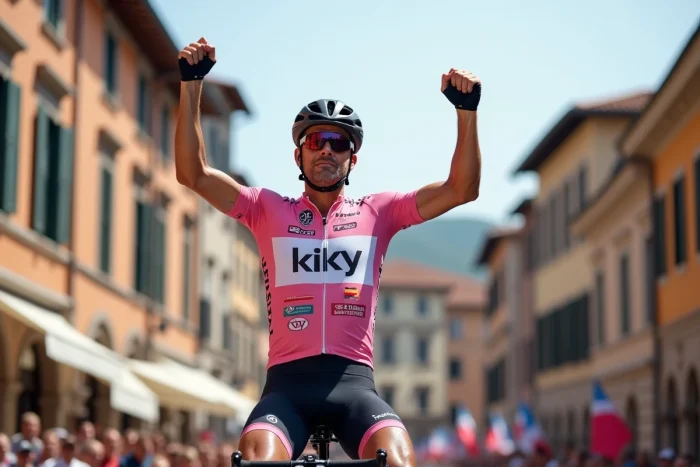
Reducing these riders to a linear ranking does not do justice to what they accomplished on the road. Jacques Anquetil dominated through time trialing, a weapon that allowed him to build sufficient leads to control the mountains without shining as brightly as his rivals. His approach was calculated, almost clinical.
Eddy Merckx operated at the opposite end. Attacking everywhere, all the time, on all terrains. His ability to win mountain stages, time trials, and even massive sprints in the same grand tour remains a unique case. The term “cannibal” was not an exaggeration.
Bernard Hinault combined brute strength with tactical intelligence. His victory at the Giro in winter conditions (snow on the Stelvio) illustrates a temperament that numbers alone cannot capture. Alberto Contador, on the other hand, represented the pure climber who developed a sufficient time trialing ability to keep specialists at bay. His attacking style, dancing on the pedals, contrasted with Anquetil’s mechanical regularity.
- Anquetil relied on the time trial to neutralize the mountains, a strategy that modern power data would make transparent
- Merckx accumulated stage wins in addition to the general classification, a dual objective that no grand tour leader aims for today
- Hinault imposed a physical and psychological power dynamic on his opponents and sometimes on his own teammates
- Contador attacked in the mountains with an aggressiveness that forced his rivals to respond rather than manage
Pogačar and the current generation facing the historic triple
Tadej Pogačar has already won the Tour de France and the Giro d’Italia. He only lacks the Vuelta to join the circle of winners of all three grand tours. At his age and current level, the probability is high, but cycling always reserves mechanical, tactical, or physical surprises.
Remco Evenepoel, winner of the Vuelta and road world champion, joined the Red Bull-Bora-Hansgrohe team with a program explicitly focused on the general classifications of the grand tours. His transfer illustrates a trend among WorldTour teams to build an entire collective around a single leader to maximize the chances of victory across multiple grand tours.
This team logic built for one man marks a break from previous decades. Merckx or Hinault won within teams that were certainly strong, but not structured with the same data-driven precision as today. Opinions vary on this point, with some arguing that Pogačar’s dominance is as much due to his talent as to his team’s infrastructure.
Grand tours and classics: two incompatible or complementary careers
An often-overlooked angle concerns the coexistence of grand tours and classics in the same palmarès. Merckx won Milan-San Remo, Paris-Roubaix, and the Tour in the same season. This type of versatility has almost disappeared from the professional peloton, where specialization by race type has become the norm.
Pogačar stands out as a recent exception. Winner of Flemish and Ardennes classics in addition to his grand tour successes, he replicates a pattern that was thought to be bygone. Winning the Tour of Flanders and the Tour de France in the same year directly recalls what Merckx accomplished and raises the question of comparing eras.
The difficulty of this comparison lies in the evolution of racing conditions: nutrition, training by power zones, aerodynamics, GPS reconnaissance of courses. A rider from the 1970s sometimes raced without knowing the exact profile of the next day’s stage. Comparing raw palmarès without considering these parameters is akin to comparing performances without context.
The triple crown remains the most reliable marker for identifying exceptional riders. Not because it measures speed or power, but because it tests adaptability across three terrains and three distinct racing cultures. Whether the next line of this palmarès is written in 2025 or later, the filter will remain the same: win everywhere, not just where one excels.