
A linden tree with low branches rubbing against the roof, a hedge of thuja encroaching on the neighbor’s property: in these situations, one often grabs the first available tool. The electric pruner is suitable for this type of intervention, provided you choose a model adapted to the diameter of the branches and the configuration of the terrain.
Pruning near electrical networks: a constraint that conditions everything else
Before comparing models, it is essential to check a point that most buying guides overlook: the presence of electrical lines near the trees to be pruned. An electric pruner, even a lightweight one, does not make the intervention safe if cables run through the work area.
Article R554-25 of the Environmental Code imposes regulatory distances between the operator and the networks. Depending on the voltage, prior notification and appropriate authorization may be required. In this case, it is better to entrust the job to a qualified professional rather than investing in equipment unsuitable for the situation.
If your trees are clear of any lines, you can move on to choosing the machine. The resources available on elagueuse-warrior.com allow you to compare the technical characteristics of different models on the market before making a decision.
Telescopic pruner or pruning chainsaw: two tools for two uses

These two categories are often confused. The pruning chainsaw (known as “top handle”) is operated with one hand, at height, harnessed to a tree or on a platform. Its use on the ground is prohibited in France for safety reasons. It is suitable for professional pruners who work in the canopy.
The telescopic pruner, on the other hand, is maneuvered from the ground. The cutting head is fixed at the end of a fixed or telescopic pole, allowing access to branches located several meters high without leaving the ground. For an individual maintaining their garden, this is generally the most suitable format.
Fixed pole or telescopic pole
The fixed pole offers less vibration and better cutting precision. The telescopic pole allows for varying the working height, but its weight increases with extension. Feedback varies on this point: some users find the telescopic pole stable enough, while others prefer the rigidity of a fixed pole for precision cuts.
Battery or corded: criteria for choosing an electric pruner
The choice between a battery-powered pruner and a corded model directly depends on the size of the area and the distance between the trees and a power outlet.
- The corded pruner (230V) offers constant power and a reduced weight since it does not carry a battery. Its limitation: the cable, which restricts the work area and complicates interventions at height.
- The battery-powered pruner frees up movement and allows work far from any outlet. The autonomy varies according to the battery capacity and the diameter of the branches being cut. For extended sessions, plan for a spare battery.
- In both cases, the noise level remains well below that of a thermal model, a concrete advantage in residential areas where noise disturbances can be problematic with neighbors.
For a small garden with a few trees close to the house, the corded model is sufficient. As soon as the area expands or the trees are scattered, the battery becomes the logical choice.
Guide length and chain: adapting the cut to the diameter of the branches
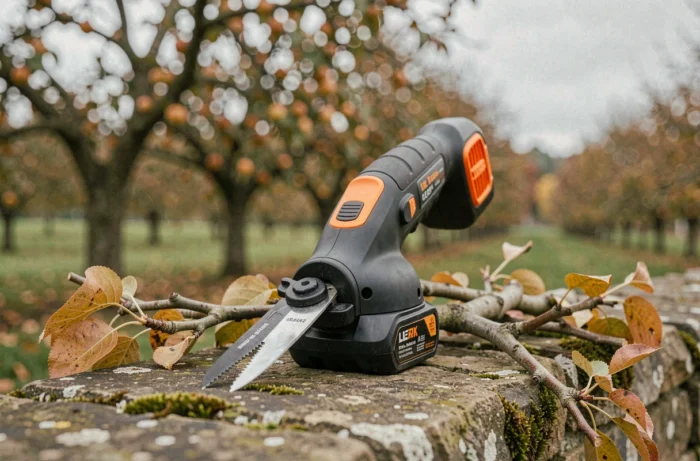
The length of the guide bar determines the maximum diameter of branches that the pruner can cut in a single pass. A short guide (around 20 cm) is suitable for dead wood, twigs, and small diameter branches. A longer guide allows tackling thicker branches but adds weight and reduces maneuverability.
Choosing the shortest guide compatible with your actual needs remains the best approach. An oversized guide on a pruning pole creates an imbalance that fatigues the arms and decreases precision.
Chain tension and type
Low-profile chains are designed to limit kickback. On an electric pruner intended for domestic use, this type of chain offers a good compromise between safety and cutting efficiency. The chain tension should be checked before each use: a loose chain increases the risk of derailment and prematurely damages the guide.
Pruning season and biodiversity: a forgotten criterion in comparisons
The French Office for Biodiversity recommends avoiding hedge trimming and pruning during the nesting period, from March 15 to July 31. This schedule applies not only to professionals: an individual pruning their trees during the breeding season may destroy active nests without even realizing it.
In practical terms, this means that the main window for using a pruner is between August and March. Planning work in the fall or late winter allows for intervention on wood in vegetative rest, which also promotes healing of cuts.
Waste management after cutting
Burning green waste from pruning is prohibited for individuals. Before purchasing a powerful pruner capable of felling large branches, one must anticipate disposal: on-site shredding, drop-off at a waste disposal site, or passing through a recycling channel. A machine that is too powerful can generate a volume of waste that is difficult to manage without an additional shredder.
The choice of an electric pruner is not limited to a comparison of technical specifications. The configuration of the terrain, proximity to electrical lines, the actual diameter of the branches to be cut, and the timing of the intervention weigh as heavily as the power of the motor or the battery capacity. Starting from the job site rather than the catalog remains the most reliable method to avoid mistakes.