What criteria truly distinguish a graduate ready to enter a 3D animation program from a candidate who will drop out in the first semester? The turnover rate of juniors in studios, the growing weight of generative AI in curricula, the Qualiopi requirement for work-study programs: these are all recent factors that redefine what it means to arrive prepared in 3D animation after high school.
Preparatory Year in Drawing and Retention Rate in Studios
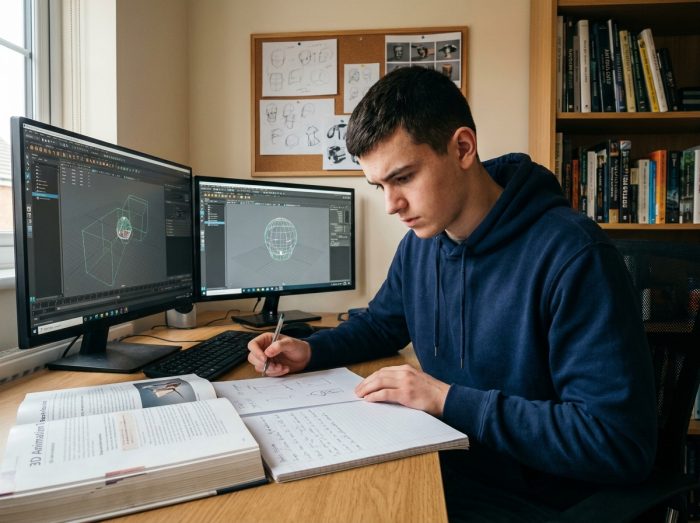
VFX studios increasingly favor graduates who have completed a preparatory year in traditional drawing and anatomy before entering a 3D program. This grounding in the fundamentals improves the retention of junior profiles in positions over time.
Mastering Blender or Maya before the start of classes is less important than the ability to draw a character in volume, understand atmospheric perspective, or compose an image. To prepare for a 3D animation program, a pencil remains a more worthwhile investment than software licenses.
Post-High School 3D Animation Programs: What Qualiopi and Generative AI Change
Two regulatory and pedagogical developments are changing the landscape of schools since early 2026. Ignoring them means choosing a program based on outdated criteria.
Qualiopi Certification and Post-High School Work-Study Programs
Since January 2026, Qualiopi certification is mandatory for any post-high school training in 3D animation eligible for work-study. Before applying, checking for this label on the school’s website is no longer optional: without it, no apprenticeship contract can be funded by an OPCO.
Programs like those at IIM display this compliance. Other, newer or less structured institutions risk losing their eligibility during the year, leaving students without funding.
Generative AI in Animation Curricula
Since mid-2025, several schools (with Gobelins leading the way) have integrated generative AI tools (Stable Diffusion, Midjourney applied to 3D) into their modeling and rigging courses. The French audiovisual production industry supports this trend, with studios seeking profiles capable of combining traditional skills and generative tools.
For a graduate, the consequence is direct: familiarizing oneself with prompting and image generation before the start of classes provides a measurable advantage. Students who arrive without any knowledge of generative AI lose several weeks catching up to their peers in these modules.
Comparison of Selection Criteria Before Application
Choosing a 3D animation program after high school involves comparing parameters that are rarely placed side by side. The table below summarizes the verification points to cross-check before submitting an application.
| Criterion | What to Check | Warning Signal |
|---|---|---|
| Qualiopi Certification | Presence on the official school website, mention in the training sheet | Absence of mention or certification “in progress” |
| Integration of Generative AI | Dedicated modules (Stable Diffusion, Midjourney 3D) in the program | Program identical to that published before 2024 |
| Preparatory Year in Art/Drawing | Option offered or partnership with a preparatory workshop | Direct entry without evaluation of drawing skills |
| Job Opportunities Outside Video Games | Partnerships with the automotive industry, architecture, advertising | Communication focused solely on gaming |
| Effective Work-Study | Number of contracts signed the previous year, partner companies | No figures provided on work-study placement |
The automotive industry has represented a higher volume of junior hires in 3D animation than video games for several years. Organizations like Peugeot Design Lab recruit post-high school profiles for the visualization of autonomous vehicles. A program that does not open up to these opportunities limits exit options.

Skills to Strengthen Between High School Graduation and Start of Animation School
The months between obtaining the high school diploma and the first day of training are often poorly utilized. Three areas of work yield concrete results, measurable from the first weeks of classes.
- Observation drawing (still lifes, urban sketches, anatomical studies): working with pencil or charcoal for two to three months enhances understanding of volume, light, and proportions, skills directly transferable to 3D modeling.
- Getting acquainted with free software like Blender: not to produce a short film, but to understand the interface, the logic of the 3D scene (viewport, camera, lighting), and to create one or two simple objects to include in a portfolio.
- Experimenting with generative AI applied to images (Stable Diffusion, Midjourney): testing prompting, comparing results with manual drawing, understanding the limitations of these tools for creating textures or visual concepts.
The portfolio serves as the tangible deliverable of this period. Two to three personal projects (a completed sketch, a 3D object, a retouched AI test) are enough to demonstrate an approach during an admission interview. Jurors from schools like IIM or Gobelins evaluate progress and curiosity more than raw technical mastery.
Paths and Level of Study After High School: Bachelor, RNCP Title, and Campus
Most programs accessible directly after high school are three-year bachelor’s degrees (level bac+3), sometimes extended into a master’s cycle. Some confer an RNCP title recognized by the state, while others provide a school diploma without official equivalence.
Checking the level of the title awarded (level 6 for a bac+3, level 7 for a bac+5) avoids unpleasant surprises upon graduation. An RNCP level 6 title in 3D animation opens access to public service competitions in digital design and facilitates international recognition of the diploma.
The choice of campus also matters: schools located near studios (Paris, Lyon, Montpellier) facilitate internships and work-study programs. A geographically isolated campus complicates access to partner companies, especially in a sector where the professional network is built from the first year.
The most reliable parameter for making a decision remains the employment rate six months after graduation published by the school, cross-referenced with the list of companies that hired graduates the previous year. If this data is not accessible, the transparency of the institution should be questioned before committing.