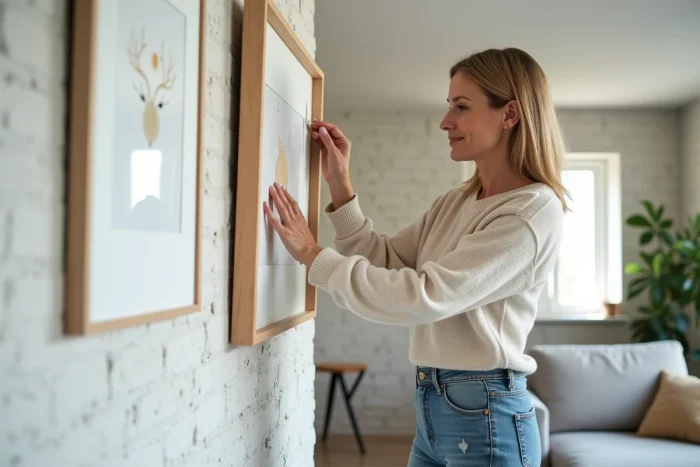
The numbers are stubborn: an adhesive can hold up to 10 kg on an uneven wall, but everything hinges on the preparation before installation. It’s the preparation of the surface that makes all the difference. Repair mortars and pastes designed for long-lasting fixing offer often underestimated options. Yet, the compatibility between the texture of a plaster and the no-drill fixings depends on the grain size of the wall, a detail that is too often overlooked when choosing the best solution.
Some manufacturers innovate with systems combining hooks and very strong glue, capable of withstanding moisture and everyday vibrations. However, these same manufacturers limit their promises to perfectly maintained surfaces: clean, dry, and dust-free. In short, most old walls don’t even come into consideration.
Why does plaster complicate no-drill fixing?
Plaster, with its typical roughness, poses unexpected resistance to fixing techniques that promise to free you from the drill. The surface, grainy and uneven, leaves no chance for ordinary adhesives to adhere over the entire area. The result: the hold depends on a few protrusions, the weight is poorly distributed, and the fixing gives way faster than one would like.
One solution: prepare the wall carefully. Clean, degrease, fill in holes or cracks. A dusty or crumbling plaster undermines all attempts at no-drill fixing. Temporary solutions like fixing paste work for very light objects, but nothing more. To improve resistance, applying a smoothing compound helps to even out the surface, making the wall compatible with strong strips or glues. On more ambitious projects, installing a drywall or glass fabric helps to flatten or mask irregularities, starting from a solid base.
Fixing without drilling on a plaster wall requires taming the porosity and fragility of the surface. Effective methods demand adjusting the technique according to the nature of the wall, without ever skimping on preparation. On a non-woven wallpaper, avoid any fixing without prior smoothing of the plaster. Finding the right balance between aesthetics and technical constraints remains key, to fix without damaging and limit disappointments.
Overview of effective solutions for hanging without drilling on a plaster wall
To successfully achieve a no-drill fixing on plaster, you need to choose a method suited to the roughness of the wall and the weight of the object. Several options exist, each with its advantages and limitations. For lightweight objects, fixing paste does the job: perfect for light frames or small decorations, it supports up to 1 kg. Adhesive hooks expand the possibilities up to 2 kg and allow for hanging dish towels, small mirrors, or decorative accessories.
Beyond that, mastic glue takes over. In blobs or cords, it allows for securely fixing medium-sized shelves or frames on plaster, up to about 5 kg. For a more robust fixing, polymer glue stands out as a reference. Its holding capacity exceeds 100 kg/m², it withstands weather and UV rays, a real asset for outdoor use. However, its permanent nature requires careful consideration before taking action.
Here’s an overview of solutions that meet specific needs:
- To be able to remove the fixing without leaving traces, reinforced adhesive strips are ideal: they hold up to 10 kg on a smooth wall and can be removed as easily as they are applied.
- In a bathroom or kitchen, choose a waterproof adhesive hook: it retains its adhesion even when exposed to water or steam.
- A decorative panel or a pre-pasted panoramic wallpaper can also refresh a plaster wall without drilling or damaging it.
Fixing on plaster is therefore always a question of compromise between ease of removal, strength, and type of support. Before choosing, assess the weight of the object, the location, and the frequency of use. Adjust the method to the context to limit unpleasant surprises, such as premature peeling or unexpected falls.
Practical tips for choosing and testing the best method at home
Before attempting a no-drill fixing on a plaster wall, it is essential to check the condition of the surface. If the wall is dirty, greasy, or crumbling, adhesion will never be optimal. A slightly damp microfiber cloth with household alcohol can effectively degrease and remove dust. A vacuum cleaner is also very useful, especially for cleaning hard-to-reach textures or corners.
To test a solution on a lightweight object, apply fixing paste or an adhesive hook in a discreet spot. Wait twenty-four hours, then test the hold: some adhesives are sensitive to humidity or temperature variations. If the wall is very uneven, prioritize products based on mastic glue or polymer glue to ensure a solid fixing.
If alignment matters, for example for a series of frames, don’t hesitate to use a laser level. For areas exposed to water, like the bathroom, opt for a waterproof adhesive hook or a water-resistant glue. If the load or the wall configuration exceeds the capabilities of no-drill solutions, calling on a multi-service craftsman may be the best option.
Adapt each solution to the nature of the wall and the weight to be fixed. For heavy objects on exterior plaster, it may sometimes be necessary to drill, using a percussion drill and an appropriate bit. For everyday needs, no-drill fixing remains an ally for preserving the wall, provided you take care in preparation and test the strength of the installation. Fixing without drilling on plaster means accepting to work with the material, experimenting, and sometimes starting over. But it also offers the freedom to change your mind without leaving traces behind.