
Since 2023, SNCF has strengthened the labeling requirement on TGV INOUI trains. Onboard teams can now refuse an unidentified bag in case of crowding or security issues. On the airline side, companies also require visible identification on each checked suitcase. Downloading and printing a compliant label before departure has become a logistical reflex, but formats and requirements vary by carrier.
SNCF QR code luggage tag and personal data protection
The official SNCF service (etiquettebagage.sncf.com) offers a tag with a QR code where the traveler’s contact details no longer appear in plain text. The name, address, and phone number are stored in a database accessible only by authorized agents.
This technical choice meets the data minimization requirements of the GDPR. Displaying personal information on a traditional cardboard tag makes it readable by anyone in a carriage or on a baggage carousel. The QR code anonymizes the tag while allowing identification by authorized personnel.
The QR tag is reusable. It is generated online, downloaded in PDF format, and printed on standard paper. Those looking for a printable luggage tag compatible with SNCF and airlines will find in this type of template a solution that covers the train without modification. For air travel, the requirements differ on several points.

Differences between luggage tags for trains and planes
SNCF requires identification of the owner without imposing a rigid format. The tag can be made of cardboard, leather, PVC, or printed on paper, as long as it remains legible and securely attached to the luggage.
Airlines add specific constraints. The format must withstand handling in the hold (rain, friction, partial tearing). A paper tag simply slipped into a plastic tag holder generally passes, but an A4 sheet folded and taped is unlikely to survive the journey from the check-in counter to the arrival carousel.
What a compliant tag must contain in both cases
- Traveler’s first and last name, clearly legible (avoid fancy fonts that are too small)
- A valid phone number, ideally a mobile reachable abroad if the flight is international
- A destination or home address, according to the airline’s instructions
- For flights, the destination airport code (e.g., CDG, ORY, LYS) is recommended by several carriers
A single PDF template does not automatically cover all airlines. Some low-cost carriers impose their own tags generated during online check-in. Checking the airline’s conditions before printing avoids finding oneself at the counter with a non-compliant document.
Paper weight and lamination for a durable printed tag
Most PDF templates available online are designed for standard A4 paper. The problem: a regular sheet tears at the first contact with moisture or friction in the hold.
A sufficiently dense paper weight changes the lifespan of the tag. Using cardstock instead of standard office paper significantly improves durability. Laminating, even with a simple adhesive sleeve, protects the print from water and abrasion.
For trains, the constraint is lower. The tag remains in a dry environment and undergoes little handling. Standard paper is sufficient in most situations, provided the print is legible and the attachment to the luggage is reliable.
Attaching the tag so it doesn’t come off
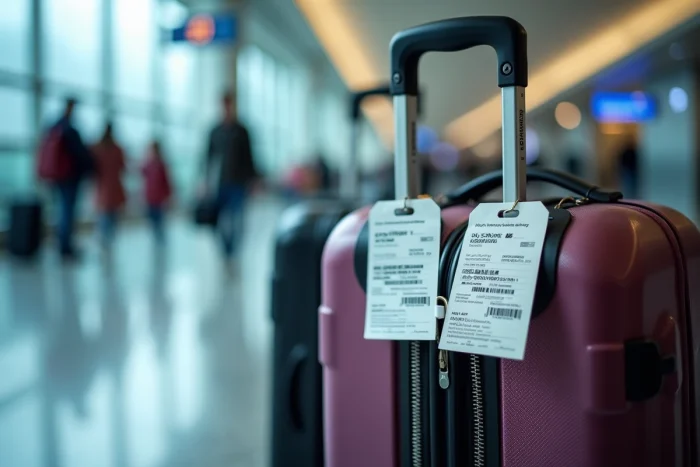
Transparent window tag holders, often provided with new suitcases, remain the most reliable solution for a printed tag. If not, a plastic thread passed through a hole punched in the corner of the cardboard tag serves as a proper attachment.
Avoid adhesive tape directly on the suitcase shell: it peels off with heat in the hold and leaves sticky residues. Single-use adhesive tags exist but pose a readability problem after a few hours of exposure to airport handling.
Limitations of free online tags and sustainable alternatives
Several sites offer customizable tag generators with options for theme, language, and number per page. These tools are handy for quick fixes, but field feedback varies on this point: the print quality entirely depends on the printer and paper used by the traveler.
A leather or rigid PVC luggage tag, reusable for several years, represents a modest investment compared to the cost of a lost or delayed bag. SNCF also distributes free tags at ticket counters and information points in stations, including versions with QR codes for those without a printer.
Connected tags (with integrated Bluetooth tracker) represent another avenue. They do not replace the regulatory tag required by carriers but add a layer of location in case of loss. The available data do not allow conclusions about their long-term reliability, as technologies and models evolve rapidly.
The printable PDF format remains the most accessible solution for preparing a train or plane trip from home. Checking the carrier’s requirements before printing helps avoid unpleasant surprises at boarding time, whether at the station or the airport.